
Designing With Low Ceilings in Historic Homes
April 15, 2026Low ceilings are a common characteristic of many historic New England homes. At the time, 7-foot ceilings were a practical design choice, helping conserve heat in an era before modern insulation and energy efficiency. While these proportions can create a sense of warmth and intimacy, they may also feel restrictive by today’s standards. Rather than viewing low ceilings as a limitation, our team approaches them as an opportunity to thoughtfully refine proportion, enhance natural light, and improve the overall flow of the home.
Understanding where structural changes are possible and where they are not is the first step. In some historic homes, ceiling height can be adjusted by opening up the framing or by reworking specific areas to add height. But many projects, especially in condos or dense urban layouts, like the Back Bay, require working within fixed constraints.
Low-Ceiling Home Design and Working With Sightlines & Windows
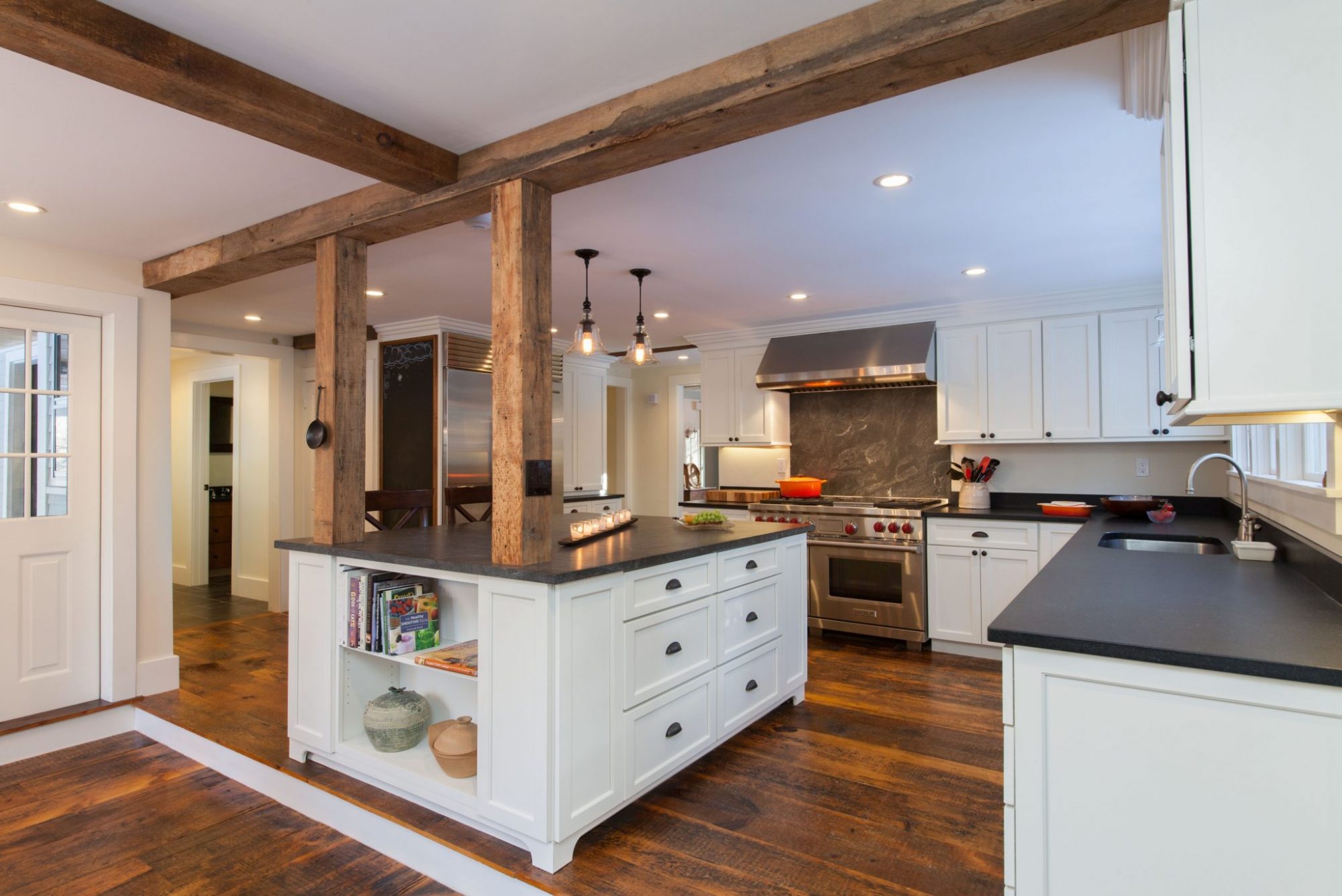
One of the most effective ways to improve perceived height is through sightlines. By opening connections between rooms or aligning views across a space, the eye is drawn horizontally, creating a sense of openness that offsets lower ceilings. At the Residence on Moore Farm in Sudbury, MA, our approach was to create a more expansive feel throughout the home. Rather than relying solely on vertical height, the design emphasizes continuity, allowing spaces to flow visually from one to the next.
Windows play an important role in making spaces feel more open and expansive. Taller window openings can help stretch the perceived height of a room. Even when structural changes aren’t possible, carefully placed windows and glass maximize natural light; when light can travel farther, spaces feel brighter and less confined.
Deep in the city or in multi-unit complexes, such as our project, the Loft on Washington Street, where ceiling heights are often fixed, maximizing daylight is essential for enhancing spatial quality.
Lighting & Color Opportunities
Uplighting can draw attention upward and soften ceiling lines quite effectively; it’s one of the most tried-and-true strategies a designer has. At the same time, layered lighting creates depth and dimension within a room. For example, wall sconces and indirect light sources can be used to distribute light evenly without drawing attention to the ceiling height itself.
Material choices and color selection also influence our perception of indoor spaces. High-gloss paint finishes can reflect light and expand the visual boundaries of a space. Lighter color tones tend to open up rooms, whereas darker, high-contrast tones make spaces feel more intimate (think a cozy pub or study with bold dark woods and colors).
Low-Ceiling Home Design Strategies
An experienced home addition architecture team can address the constraints of low ceilings, whether that may involve expanding the home’s footprint or reconfiguring adjacent spaces if possible, or working with other design elements when structural and foundational changes are not possible.
As one of the premier Boston architecture firms, we regularly design within these constraints, particularly for historic homes and urban properties.
Contact our team today, and let’s begin discussing your next home renovation project.
